
Email marketing is still one of the most powerful tools for digital marketers. Yet, even with all the advancements in technology and data-driven insights, many email marketers still grapple with a crucial metric: the email open rate. If your email open rates aren’t where you’d like them to be, don’t worry—you’re not alone, and you’re not out of luck.
With this comprehensive guide, we’re just about to deep-dive into the average email open rates, what controls those metrics, and how to take them higher using only guaranteed methods. On a more personal level, we will show you all you need to know to turn underperforming emails into marketing devices.
Understanding Email Open Rates: Setting the Benchmark
Therefore, before turning to tactics, you should finally understand what the email open rate is and why it is so important. The email open rate is the percentage of subscribers who opened a certain email out of the total number of subscribers to which that email was sent. This serves as one of the most critical indicators of how well your subject lines, sender names, and preheader texts are doing.
Almost 7 billion messages were analysed which led to a global average email open rate of 19.66%. As stated, it is just a global benchmark, and actual figures are likely to vary much based on factors such as location, industry type, business type, and the nature of the email.
The location makes a difference. For example, you can establish a general benchmark email open rate at about 26%, assuming that most of your audience is in the European region. North American businesses should be closer to 23.53% rates.
Restaurants & Food industries have an average email open rate of 32.04%, Non-Profits are at 31.73%, Automotive at 30.87%, and Real Estate at 28.57%.
Factors That Influence Your Email Open Rates
- Audience Location: Geographic factors play a significant role in email engagement. Tailoring your send times and content to fit the preferences of your target regions can improve your metrics.
- Industry Type: Certain industries inherently attract higher email open rates. Understanding the norms within your industry helps set realistic expectations and identify areas for improvement.
- B2B vs. B2C Dynamics: Business type affects how your audience interacts with your emails. B2B emails might need a more formal tone and business-related content, while B2C emails can be more casual and entertaining.
- Email Type and Timing: The type of email—whether it’s a newsletter, promotional offer, or event invite—can influence email open rates. Additionally, sending emails at optimal times when your audience is most likely to check their inbox can make a big difference.
Why Email Open Rates Are Tougher to Measure?
Changes like Apple’s Mail Privacy Protection have made it harder to accurately measure email open rates. While this metric is less precise than it used to be, it still offers valuable insights into the overall health of your email campaigns and deliverability. Despite the challenges, email open rates remain a critical part of your email marketing toolkit.
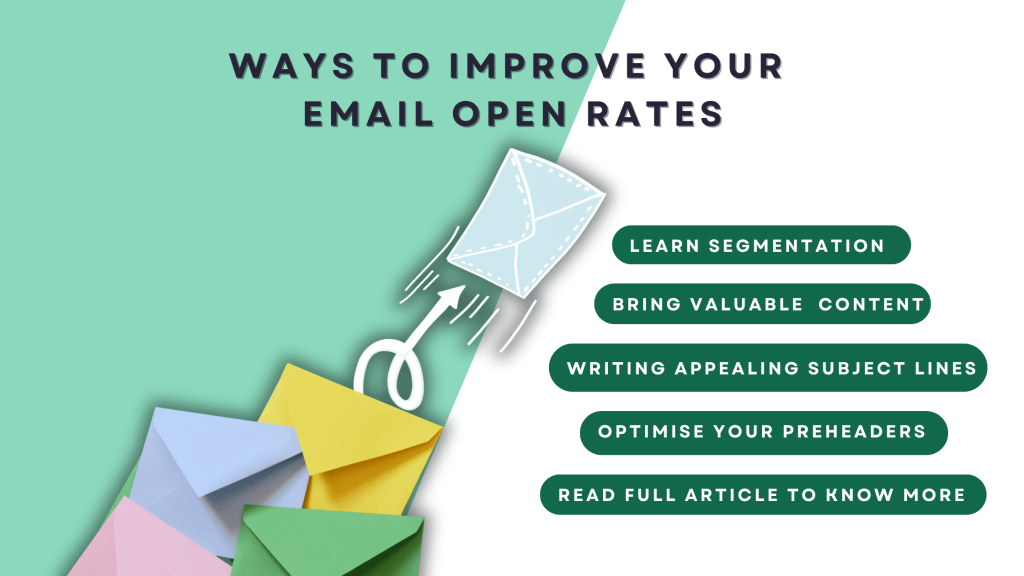
Some Proven Ways to Improve Your Email Open Rates
Now that we have those out of the way, let’s get down to some actionable strategies sure to help you boost your email open rate consistently. This data-inspired technique has been fitted into the modern rules of email marketing.
Learn Segmentation
Email Segmentation is more than just a fancy word; it’s a game-changer. You can divide your email list into targeted groups by sending content that matters to each segment.

Here are four powerful segmentation strategies that you can use in your email campaigns
- Demographic Segmentation: In B2C, one can target based on individual attributes, gender, location, or income- to customise the content.
- Firmographic Segmentation (B2B): Segment based on company size, industry, or location to make your messaging more relevant.
- Psychographic Segmentation: Dive deeper into your audience’s values, beliefs, and interests to create content that truly connects.
- Behavioural Segmentation: Track user behaviours like past purchases, email engagement, or website activity to tailor your messages.
Knowing your audience on a better level gives you the ability to deliver relevant and more personalised content.
Bring Value-Packed Content
Think about it: your content can’t just be promotions; it has to be of value to your subscribers.

Here’s how to make your email’s content a bit difficult to ignore:
- Personalisation beyond a first name: Go beyond plain personalisation. Address your subscribers’ points of pain, highlight benefits that mean a lot to them, and make sure your messaging corresponds to their stage in the customer journey.
- Relevance Rules: That means avoiding generic content for email. Instead, write the messages that will speak directly to your segments. Perhaps your B2B audience will appreciate a whitepaper, but the subscribers of the B2C audience prefer an offer for a discount.
- Problem Solving: Every email should solve a particular problem or satisfy a certain need. Whether it be in the B2B or B2C space, positioning your brand as the solution provider builds trust and gets them coming back for more.
This is where the 80/20 rule comes in-your emails should always constitute 80% value propagation without pitching, while 20% could be promotional. It’s all about finding that perfect spot so your audience will be informed, engaged, and responsive to you.
Writing Appealing Subject Lines
Your subject line is the first and in many cases (if you are just getting started), the only opportunity to persuade someone to open your email.

To cut through the noise of a crowded inbox, your subject lines should be:
- Short and Sweet: Be concise while still saying what needs to be said.
- Interesting and Relevant: Engage interest, not deception. Connect the subject with your email content.
- Personal and Urgent: Make elements of your subject line both personal and urgent.
- Play with Elements: Since emojis, numbers, and “power words” stir emotions, use them. At the same time, pay attention to performance metrics since what works for one audience does not work for another.
Personalised subject lines underperformed, averaging 18.79% OR compared with 22.14% for non-personalised lines. Try and test what works for your targeted audience.
Optimise Your Preheaders
Preheaders/ preview texts- are the subtitles to your subject line, adding a bit more context to your email and too often determining whether it will get opened.

- Use this space to complement your subject line with more details or a hook that can be engaging.
- If you don’t specify a preheader, email providers will automatically pull the first line of your email content, which is generally not good.
If your subject line reads “Unlock Your Free Guide,” a great preheader could be “Get insider tips on boosting your marketing in 2024.”
Emails with optimised preheaders observed an average email open rate of 25.83%, which is significantly higher than the industry standard.
Optimise Your Send Time
Timing is everything and the most important aspect of email marketing and of course no one-size-fits-all answer. However, data does show that early mornings around 4-5 AM and after work hours around 6 PM serve up better email open rates.

- Day of the week: It is less important exactly which day is used, while weekdays typically perform best – assuming working professionals are being targeted.
- Use Tools for Precision: Tools like GetResponse’s Perfect Timing can analyse when your audience is most active and optimise send times accordingly.
Emails sent using optimised timing features observed an average email open rate of 22.75%, outperforming the industry standard by over three percentage points.
Keep yourself out of spammy folders.
Landing in the spam folder is one of the worst outcomes for any email marketer.

To avoid this, you can follow some tips below.:
- Permission: Always email people who have opted in. Don’t buy lists and engage in some suspect tactics to build your list.
- Be Transparent: Let subscribers know what they will be getting and how often. Transparency builds trust and reduces spam complaints.
- Use a Reputable ESP: A good ESP focuses on deliverability and follows all of the industry standards that keep them in conformance with spam laws.
- List Hygiene: Regular cleaning means removing inactive subscribers and correcting invalid addresses from the email list. Proven Ways to Increase Your Email Open Rates.
Maintain a Healthy Email List
A solid email list plays a significant role. If you want high email open rates and overall success with your campaigns.
Here’s how to keep your list in good shape::
- Cleaning Your List regularly: These would include hard bounces, inactive users, and duplicates. Verify email addresses for accuracy by using tools and make sure they are still valid.
- Re-engage Dormant Subscribers: Send targeted campaigns to inactive subscribers to win them back. If they don’t re-engage, consider removing them from your list to maintain high deliverability.
Keeping your list fresh and engaged will help maintain high email open rates and improve overall campaign performance.
A/B Test Everything
A/B testing is known as testing which is a method for improving your strategic plan for emails. In this way, it is possible to discover which aspects of the multiple versions of the emails your audience is the most interested in.

- Subject Lines: Experiment with the variations of subject lines that fit most to lure the readers. There is a way to infer it, which could be as simple as changing the length of the text, changing the tone, personalised approach or even using emojis.
- Content and Format: You can try changing the format of the content, the images or the location of the CTA to another area. The thing is to find that design and the message that will attract the most people.
- Sending Times: Test different times and days to send your emails. You might find that your audience engages better at times you hadn’t initially considered.
- Personalisation and Segmentation: Test different levels of personalisation and segmentation to see what drives the highest engagement.
Start with one variable at a time to accurately gauge what’s driving the change in performance. Once you identify the winning variations, implement them across your broader campaign strategy.
Leverage Email Authentication Protocols
For your emails to be delivered to subscribers’ inboxes, authenticate your emails using the below protocols; Sender Policy Framework (SPF), DomainKeys Identified Mail (DKIM), and Domain-based Message Authentication Reporting and Conformance (DMARC).
- SPF: Have the capability of ensuring that your emails are sent from an authorised server.
- DKIM: Opens up the ability for senders to digitally sign emails, so the recipients receiving the emails can confirm the sender.
- DMARC: Gives directions to ISPs on how to deal with unauthenticated messages.
Authentication protocols assist you in putting up an effective sending reputation that makes it easy for your emails to be delivered to the inbox rather than the spam folder.
Optimise for Mobile
Because more and more emails are opened on mobile devices, currently more than 50%, your messages must be mobile-optimised. Some common negative impacts of a bad mobile experience include low email open rate and low level of engagement among the target customers or audiences.
- Responsive Design: When addressing the issue of designing responsive email templates, one needs to make sure that email templates are responsive. This will make your content properly geared for the 2 devices that are forced into our lives today, desktops and mobile devices.
- Short and Scannable Content: To reinforce, the character of mobile users that they only wish to read short overviews. Always ensure that you write brief and to the point with a clear tap on Call to Actions in the content.
- Test Across Devices: For any predictions relating to email, use multiple computers and web browsers to review how the particular email will appear.
Use a one-click CTA button which makes it easier to engage especially when a person is using a small screen of a mobile device.
Make Use of Analytics and Insights
Consistently monitoring and reviewing your email analytics is quite important for understanding what’s working for you and what isn’t. Key metrics to monitor include:

Some terms you should know about.
- Click-Through Rates (CTR): It’s the percentage of recipients who clicked on a link within your email.
- Conversion Rates: The percentage of recipients who took the desired action, such as making a purchase or signing up for a webinar.
- Bounce Rates: The percentage of emails that couldn’t be delivered.
- Unsubscribe Rates: The overall percentage of recipients who opt out of your emails.
Data analysis gives an understanding of your target market and assists you in making modifications to your approach as you progress. Leverage them to add to the and build on what is positive while eliminating and minimising negative aspects.
Engage Through Automation
Email automation will help in making your marketing timely enough to reach your audience with relevant and effective messages.
Following are some of the ways through which you can take advantage of automation:
- There should be a series of emails to introduce the new subscribers to the brand to let them know what to expect from the emails and the value they will receive.
- Use behavioural triggers to send automated emails based on actions taken by your subscribers, such as abandoning a cart or downloading a resource. Automatically target inactive subscribers with re-engagement campaigns to rekindle interest.
Automated emails often have higher email open rates because they’re timely, relevant, and personalised to the recipient’s actions or status.
Build an Empathy
Now, the kind of emails that tend to elicit an urgent response from the recipients is the kind that tends to create an element of urgency. This is especially important when it comes to promotion time constraints to pass such messages as “Limited Time Offer,” “Only a Few Left,” or “Ends Tonight. ”

- Be Genuine: In particular, one should not overemphasise urgency tactics since it will be seen as dishonest. Consume them when necessary, and only when the situation requires so.
- Clear Call to Action: Always make sure that your Call to Action is consistent with the urgency message so that the recipients can follow the given path easily.
Another technique that can be applied is the application of countdown timers to the pointed emails to make the client visually impressed by the given sense of urgency. This can be quite good for flash sales or for a time-sensitive event such as the upcoming holiday break, for instance.
Experiment with Interactive Content
But it is never a bad idea to make your emails as engaging and as memorable as possible and that can be done by incorporating interactive content.
Consider incorporating elements like:
- Surveys and Polls: Make it possible for the subscribers to give their feedback within the email.
- GIFs and Videos: Make use of movement, and motion to draw attention and make one’s content striking.
- Gamified Content: We should incorporate fun-based types of content such as quizzes, scratch-offs, spin-to-win, etc., that will keep the readers more engaged with the email content.
Incorporation of the interactivity of the content gives the recipient more time to be acquainted with the mail hence enhancing the overall open and the engagement rates.
Conclusion
Thus, increasing the email open rates is also an ongoing process which directly depends on the audience’s needs, testing, and valuable content. Remember, all these techniques discussed in this guide, ranging from perfect segmenting to creating the right subject line to the right sending time, or even incorporating automation can make your email marketing extremely great and impactful.
Just as a reminder – the main principle of working with email marketing remains the same – people should always stay in the centre. So, always continue the testing, continue to iterate and continue to refine your approach based on your audience. In other words, stick with your emails and use the correct strategy and the email open rate will skyrocket with the engagement, sales and success of the business that follows.
We hope you enjoy our post as much as we enjoyed creating it. We believe that if you wish to access digital marketing to its full potential, you could link up with It’s Solved World.
Happy emailing!
